Your company still can’t think without you.
A stronger organization. A freer you. And KPIs that prove it.
Every decision that matters still comes back through you — not because your people are weak, but because what you know has never been written down anywhere they can reach it. Organizational Independence is how that changes.
Four situations
Which of these is yours?
Work still waits on me to approve, check or fix it — even when it was done well.
The standardOur standards are not written down well enough that someone new could do the work our way without me explaining it.
The driftOur standard has slowly shifted to match what AI produces, without anyone deciding to change it.
The decisionMy team cannot make important decisions the way I would make them without asking me.
The check asks you about all four, and three more you have probably not put words to.
The money
Which number moved?
Your team is probably faster. You may well have saved money, or grown revenue. So the question is not whether AI did anything — it is how much checking, fixing and deciding still comes back to you.
Four things are worth putting a figure against: your time, your costs, your revenue and your workload. Most owners can answer two of them quickly and go quiet on the other two. Whichever ones you cannot answer is the point — not because the spend was wasted, but because nobody set a number for it to move before the work started.
The check asks what you spend on AI each month. Every band from nothing yet to over ten thousand is on the list, and so is I don’t know. If that last one is your honest answer, you already have the finding.
AI has to show you the money. Not more output, not more activity — revenue or profit, measurably, while the work is still done your way, to your standard, by your frameworks. A build that moves a number by abandoning how your company operates buys you a quarter and costs you the thing that made the company worth running.
That is a test, and it is yours to carry. Ask it of every vendor selling you AI this year. Ask it of us.
The org chart
You did not hire a person. You hired a third of one.
Every position in your company holds three roles. Strategic decides what should be done and why that. Tactical does the thing. Analytical says whether it worked and how to do it better.
You drew one box, wrote one job title in it, and hired one person. Look at where the other two roles went.
This is why a good hire can still frustrate you. They are not strategic enough, or analytical enough — and that is what you need from them, but it is not who they are. The gap was in the chart before they arrived.
And AI fills one role. It does not fill a position.
Position — Marketing Manager
Strategic
What should we do, and why that?
Held by: you
Tactical
Doing the thing.
Held by: the person you hired
Analytical
Did it work? Did we measure it?
Held by: you
Now draw the same three boxes under every other position in your company, and put a name in each one.
The framework
Three questions a leader has to be able to answer
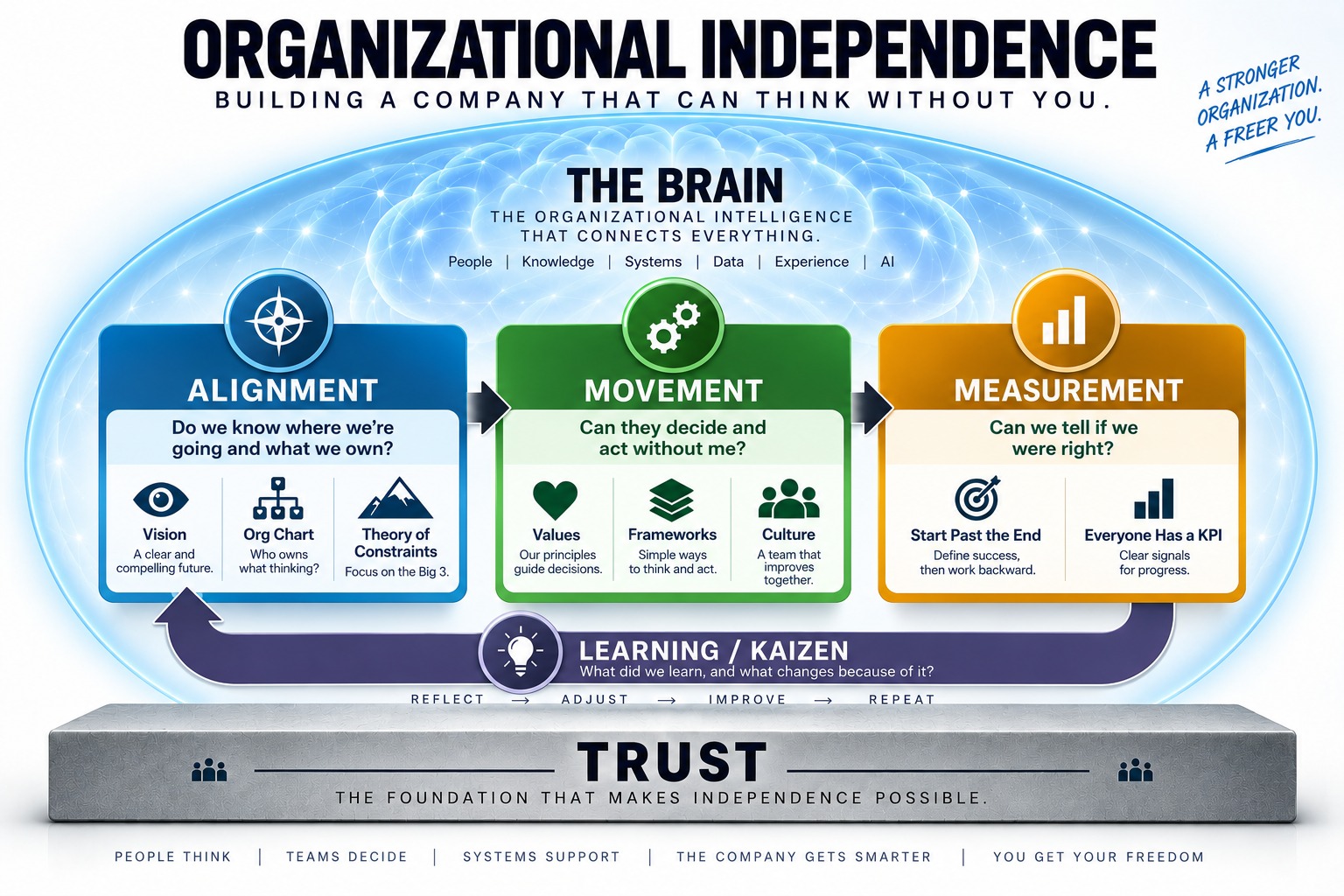
Not three topics — one argument. A company cannot think without you unless it knows where it is going, can decide without asking you, and can tell whether it was right.
1 · Alignment
Do we know where we are going, and what we own?
- Vision — a clear and compelling future
- Org chart — who owns what thinking
- Theory of Constraints — focus on the Big 3
2 · Movement
Can they decide and act without me?
- Values — our principles guide decisions
- Frameworks — simple ways to think and act
- Culture — a team that improves together
3 · Measurement
Can we tell if we were right?
- Start past the end — define success, then work backward
- Everyone has a KPI — clear signals for progress
↺ Learning — reflect, adjust, improve, repeat — runs back from Measurement into Alignment. Improve is the move that does the work: a lesson nobody writes into how the company operates leaves next quarter starting in the same place.
The Brain sits over all three. The organizational intelligence that connects people, knowledge, systems, data, experience and AI — so a new person inherits what the company knows on their first day instead of coming to ask you.
Trust sits under all three. It is the foundation that makes independence possible, and it is the first thing that breaks when a standard lives in one head.
What makes a KPI count
The hero promises KPIs that prove it. This is the test they have to pass — and the number itself is yours, not ours, which is why there is a test here and not a figure.
- One north star per seat
- A property of the position, not of the quarter. It does not change because the plan changed.
- It measures what the seat produces
- Never activity compliance. “Posts published” is attendance; “qualified calls booked” is output.
- Supporting measures, triggers, and the ones we reject
- A supporting measure explains the north star. A trigger says someone must act now. An activity metric is named and rejected on purpose, so it cannot quietly become the goal.

Three ways in
Learn it, install it, or build it yourself
Learn it
Events and web classes
What you receive: the framework taught in a room, and a thing you build during it — not notes about building it.
Help: Atiba teaches live, and you leave with the build working.
What it moves: the hours a week you personally spend on work somebody else was hired to finish.
Install it
OIS — organizationally independent software
What you receive: your company’s own thinking, installed as software that answers to your numbers rather than to its own feature list.
Help: an install is teaching plus software, never software alone. We work it through with you and your team.
What it moves: the revenue or profit line the seat it fills is already measured on.
Build it yourself
The Architect
What you receive: your org chart with all three roles named on every position, and the written specification for the one you decide to hand to AI.
Help: it interviews you. About twenty minutes per build, and you keep every document it produces.
What it moves: the cost and the weeks of a build that would otherwise be scoped by guessing.
Not sure which? The AI Leverage Check ends by telling you which one your answers point at.
Proof
Named. On camera. In their own words.
These are owners from medicine, retail and pharmacy rather than marketing agencies — said plainly, because what they have in common with you is being the person everything ran through, not the industry they run it in.
“What would have taken a million years has now occurred in four days.”
Oasis Regenerative Medicine, Las Vegas · regenerative medicine, not an agency
“Struggling with Shopify for three years… now I built an app. And I’m not a coder.”
Founder, The Clothing Library · retail, not an agency
“I can cut my clinical schedule, earn the same or more — more impact, through other people.”
Ortho Las Vegas · the owner-dependence result, in his own words
“I built it myself — not pay someone to do it. It made me feel like another human being.”
Marketing consultant, Philippines · the closest to your seat on this page
“A lot of times you go to something, you learn, and then you get sucked back into the chaos and forget to apply what you learned. That’s not happening with these students. Many of them are now building their own software, their own AI agents, their own automations.”

Who is behind this
Atiba de Souza
He builds the thing in the room with you. Five cohorts of owners have now sat in one of his build labs and left with working AI running in their business rather than a plan to get one.
Organizational Independence is his framework, taught in full from the Chimera stage in Singapore in September 2026 and run as a workshop since. The Architect is the same framework as software.
He teaches across South-East Asia — Singapore, the Philippines, and online — and runs the four-day build lab in Las Vegas.
What independence actually looks like
People think
Teams decide
Systems support
The company gets smarter
You get your freedom
Start by finding out where the work actually stops.
About four minutes, free, and you get the pattern your own answers describe. If you would rather just talk it through, that door is open too.