The framework
Organizational Independence
Building a company that can think without you. A stronger organization, a freer you, and KPIs that prove it.
This page teaches the whole thing. There is nothing held back for a paid room — what the paid rooms add is us building it with you.
Jump to: Vision · Values · The org chart and its three roles · The whole framework on one page
“Without you” does not mean unnecessary
Owners hear that phrase and hear you become unnecessary. It is the opposite. Independence moves you off the work anyone else could do and onto the work only you can do. The business stops waiting on you for things it should never have been waiting on you for.
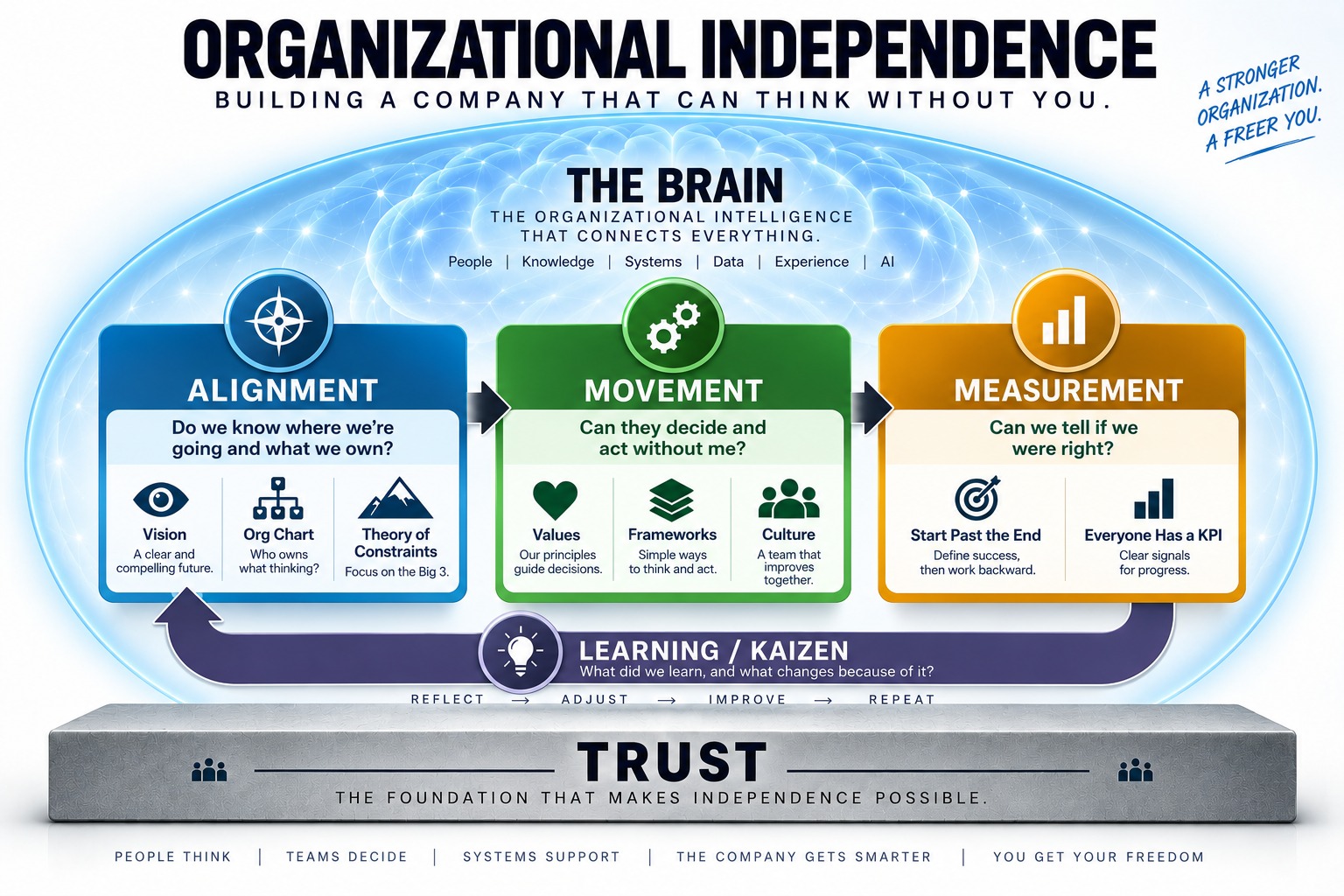
Three questions have to be answerable before that is true. They run in this order because each one is a precondition for the next: movement without alignment is a team deciding quickly in the wrong direction, and measurement without movement measures a queue waiting on the owner.
Alignment
Do we know where we are going, and what we own?
A company cannot act without you until it knows the direction and who holds which piece of the thinking. Most owners have the direction and have never written it anywhere their team can reach it.
- Vision
- A clear and compelling future, written down.
- Org chart
- Who owns what thinking — not who reports to whom.
- Theory of Constraints
- Focus on the Big 3. Optimising anything that is not the constraint is waste.
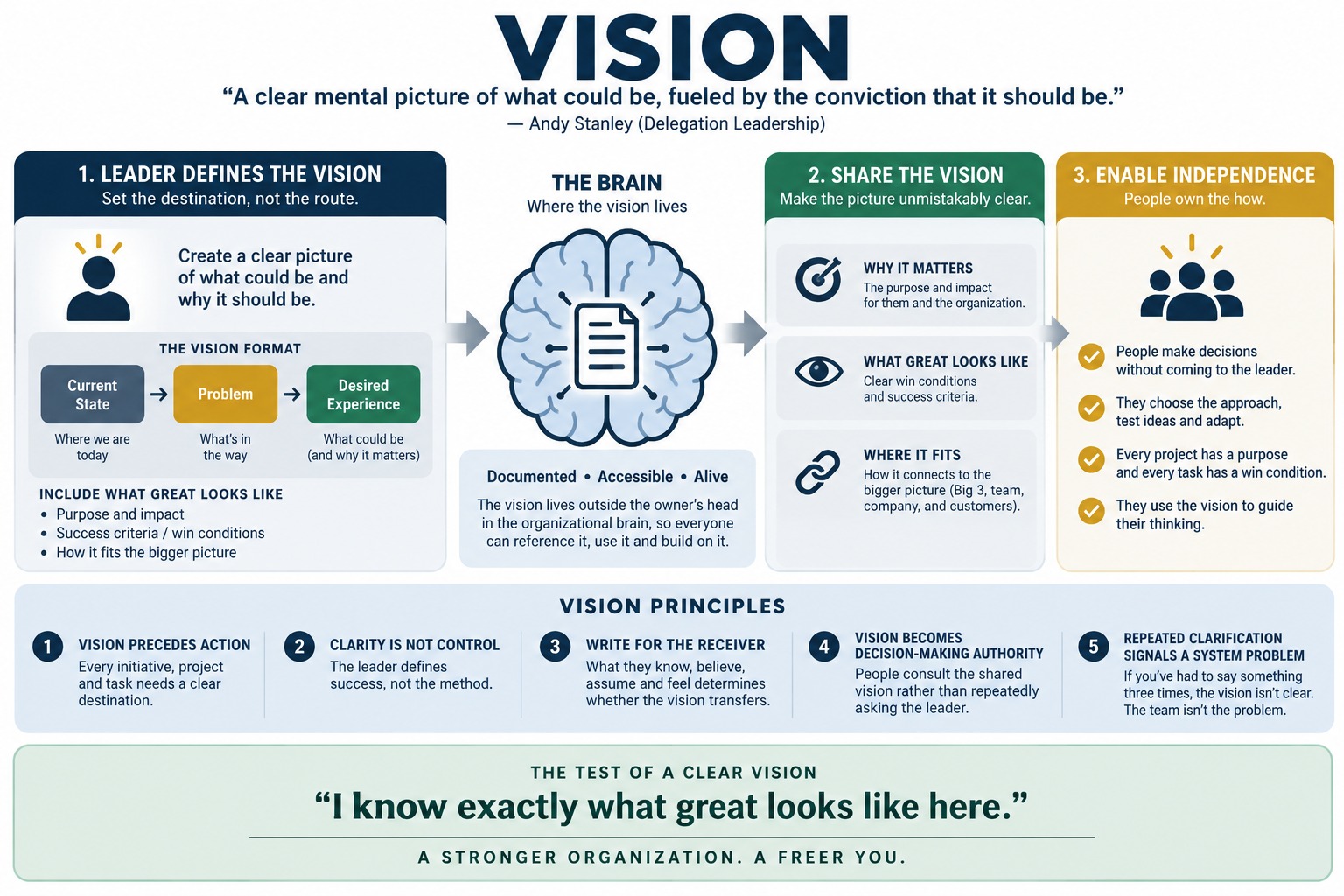
Alignment · Vision
From clarity to independence
“A clear mental picture of what could be, fueled by the conviction that it should be.” Andy Stanley’s definition, and the one we use.
Most leaders never paint the picture at the level of the actual work, so the team comes back to them for it. Set the destination, not the route.
1 · Define it
A clear picture of what could be and why it should be. Written in three moves:
Current state — where we are today
Problem — what is in the way
Desired experience — what could be, and why it matters
2 · Share it
Make the picture unmistakable. Three things, every time:
Why it matters — the purpose and the impact, for them
What great looks like — the win conditions
Where it fits — how it connects to the Big 3, the team and the customer
3 · Enable independence
People own the how. You can tell it worked when:
- they decide without coming to you
- they choose the approach, test it and adapt
- every project has a purpose and every task has a win condition
- they use the vision to guide their thinking
And it lives in the Brain, not in your head
Documented · accessible · alive. A vision that exists only in the owner’s head can only be consulted by asking the owner, which is the dependency this whole framework removes.
Five principles
1 · Vision precedes action
Every initiative, project and task needs a clear destination.
2 · Clarity is not control
The leader defines success, not the method.
3 · Write for the receiver
What they know, believe, assume and feel decides whether the vision transfers.
4 · Vision becomes authority
People consult the shared vision instead of repeatedly asking the leader.
5 · Repeated clarification is a system problem
If you have said it three times, the vision is not clear. The team is not the problem.
The test of a clear vision
“I know exactly what great looks like here.”

Movement
Can they decide and act without me?
Values and frameworks tell someone how to decide when the situation departs from the instruction. This is where most companies stall: the people are capable, and every situation the handbook did not predict comes back to the owner.
- Values
- Our principles guide decisions — including the ones nobody wrote a process for.
- Frameworks
- Simple, repeatable ways to think and act.
- Culture
- A team that improves together rather than one that waits together.
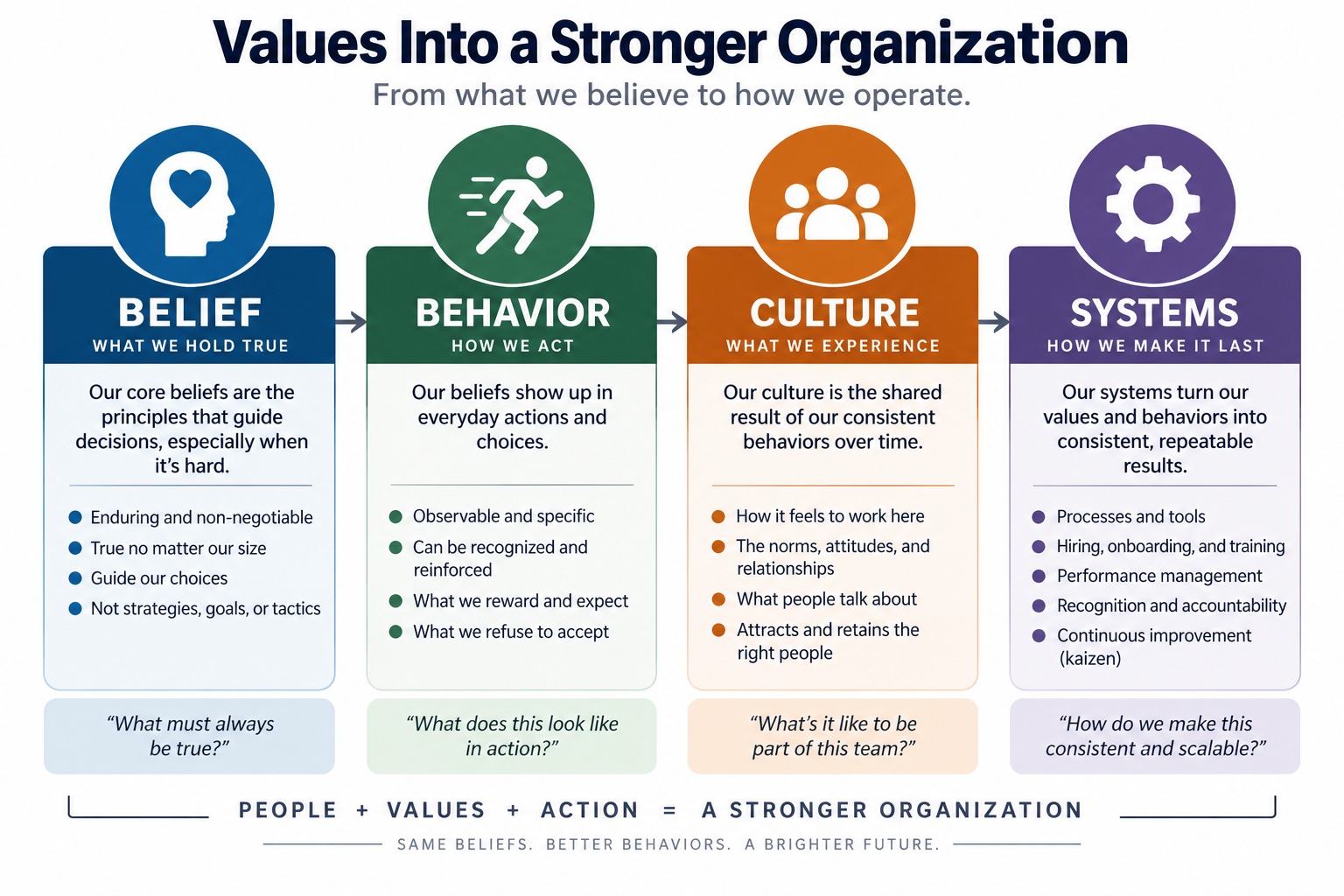
Movement · Values
From what we believe to how we operate
A value painted on a wall changes nothing. It becomes an organization in four steps, and each one is a different question.
Belief
What we hold true
The principles that guide decisions, especially when it is hard.
- enduring and non-negotiable
- true no matter our size
- not strategies, goals or tactics
“What must always be true?”
Behaviour
How we act
Beliefs showing up in everyday actions and choices.
- observable and specific
- recognised and reinforced
- what we reward, and what we refuse to accept
“What does this look like in action?”
Culture
What we experience
The shared result of consistent behaviour over time.
- how it feels to work here
- the norms, attitudes and relationships
- what attracts and keeps the right people
“What is it like to be part of this team?”
Systems
How we make it last
What turns values and behaviours into repeatable results.
- processes and tools
- hiring, onboarding and training
- performance, recognition and accountability
- continuous improvement
“How do we make this consistent and scalable?”
People + values + action = a stronger organization

Measurement
Can we tell if we were right?
Define success first and work backward to the plan — start past the end. Then every seat carries one signal that says whether it is producing.
- Start past the end
- Define what success looks like, then work backward.
- Everyone has a KPI
- Clear signals for progress, one per seat.
What makes a KPI count
Most dashboards measure attendance. A KPI that counts measures what the seat produces, and it belongs to the position rather than to the quarter — it does not change because the plan changed.
North star
One per seat. The single signal that says this position is doing its job.
Supporting measure
Explains the north star when it moves. Never a substitute for it.
Trigger
A number that says somebody has to act now, not a number to admire monthly.
Rejected on purpose
The activity metric is named and written down as rejected, so it cannot quietly become the goal.
Posts published, calls dialled, hours logged: all attendance. Qualified calls booked, gross margin per project, revenue per head: output.
The loop
Reflect, adjust, improve, repeat
Learning is not a fourth stage. It is a loop that acts on all three and returns into Alignment, because that is where a lesson becomes the next direction.
Improve is the move that does the work. A lesson noticed in a meeting and never written into how the company operates leaves next quarter starting in the same place as this one.
The mechanism
Every position holds three roles, and you have been filling the empty ones
We draw boxes, put positions in them, put names in the boxes we have hired for — and put our own name in every box we have not. That is why an owner feels like they are wearing all the hats.
Break any one position open and there are three roles inside it, each answering a different question.
Any position, opened up
Strategic
What should we do, and why that?
Tactical
Doing the thing.
Analytical
Did it work? Did we measure it, so we know how to do it better?
Most people do one of the three well. Exceptional people do two. So when a hire frustrates you, they are not strategic enough, or not analytical enough — and that is what you needed from them, but it is not who they are. The gap was in the chart before they arrived.
A restaurant owner once offered his sous chef as the counter-example: he only stirs the pot, nothing strategic about it. So who invented the Christmas specials? Well, I did. There is a strategic part of that position, and the owner was doing it. That is organizational dependence, arriving one position at a time.
AI fills one of the three. It does not fill a position. It was built by humans in their own image and it has the same limit: one role at a time, done well. If two roles on a position are empty, you build two things, not one thing doing both.
Over all three
The Brain
The organizational intelligence that connects everything — people, knowledge, systems, data, experience and AI — holding the vision, the values, the frameworks, the numbers and the lessons in one place a new person inherits on their first day.
It works as capture, connect, apply, learn, evolve. Without the connect step it is a filing cabinet. Without the apply step it is a library nobody visits.
This is why the framework is not a leadership poster. Every stage depends on the company remembering something, and a company whose memory lives in the owner’s head can only think when the owner is in the room.
Under all three
Trust
The foundation that makes independence possible. A team that does not believe it is allowed to decide will keep asking, however good the framework is.
People think · Teams decide · Systems support · The company gets smarter · You get your freedom.
The test every build has to pass
Show me the money
Freedom is the promise. A number is the proof. A build has to meet both of these, and one without the other fails in opposite directions.
It moves revenue or profit, measurably
A number someone could be shown. A build that does the work beautifully in your own voice and moves no number is a hobby with a budget.
It works your way
Your goals, your values, your frameworks. A build that moves a number by abandoning how your company operates buys a quarter and costs the thing that made the company worth running.
Bigger means revenue or profit. Not more output, not more staff, not more activity. Faster is activity. Bigger is money. We do not build because it is cool. We build to increase the bottom line.

Where does your company stop being able to think without you?
Thirteen questions, about four minutes, free. It ends by naming the pattern your answers describe and what to do about it.